MLOps in 2026: The Consolidation Was Necessary. Here's What Survived.
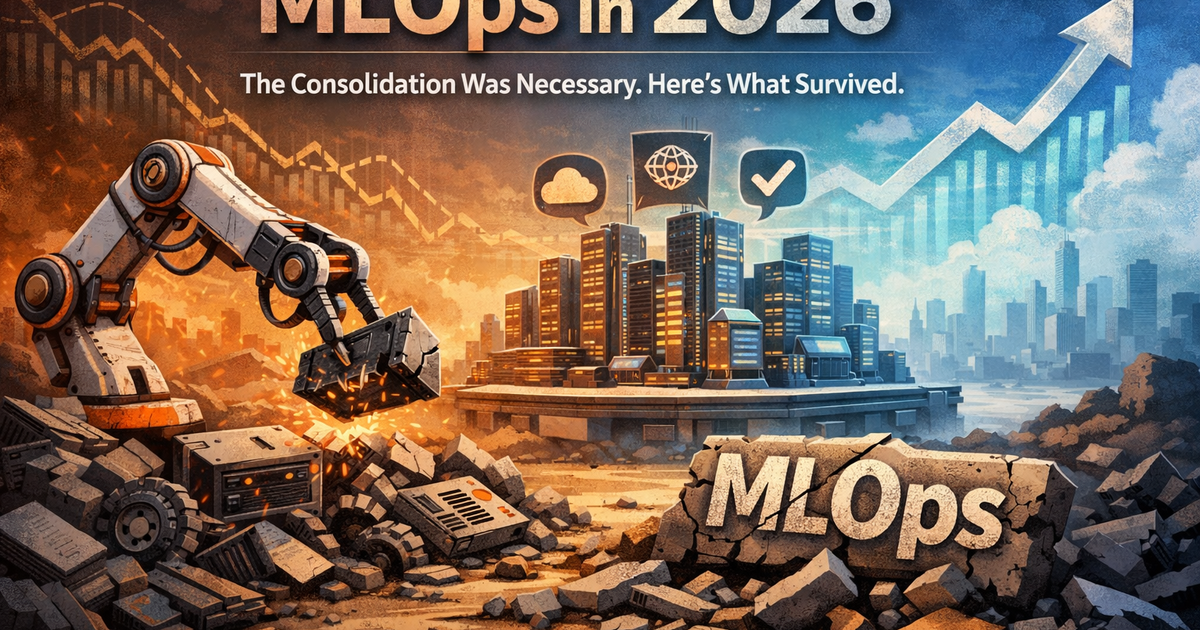
There was a period, roughly 2021 to 2023, where the MLOps tooling landscape felt like a startup generator. New experiment tracking tools, new model registries, new monitoring platforms, new feature stores — each solving one narrow slice of the ML lifecycle, each requiring its own login, its own configuration, its own learning curve. Teams assembled stacks of twelve, fifteen, sometimes more tools, most of which overlapped, several of which nobody could explain why they'd been added.
By 2026, a significant portion of that ecosystem has been rationalised out of existence. Some vendors were acquired. Some pivoted. Some quietly shut down and their customers just moved on. The consolidation was uncomfortable while it happened and genuinely useful now that it has.
The move that signalled a direction
When CoreWeave acquired Weights & Biases in early 2025 for a reported $1.7 billion, it wasn't just a big number — it was a strategic signal about where the market was heading. Weights & Biases had built the most widely-used experiment tracking and model monitoring platform in the space, trusted by OpenAI, Meta, NVIDIA, and thousands of others. CoreWeave, a GPU cloud provider, didn't buy it to keep it neutral. They bought it to vertically integrate — to make their compute infrastructure and the tooling layer a single, coherent thing.
ClearML made a similar move in a different direction, pivoting away from general-purpose MLOps toward GPU resource optimisation. DataChain shifted focus toward LLM tooling. What those pivots have in common is the same thing: the era of the all-in-one, standalone MLOps platform is over. What's replacing it is either deep integration with cloud infrastructure or deep specialisation in one thing.
What the production stack actually looks like now
In most serious ML teams today, the stack has consolidated around a smaller, more coherent set of tools.
MLflow remains the default open-source backbone for experiment tracking and model versioning — partly because it's genuinely good, partly because Databricks turned it into an enterprise product with real support behind it, and partly because teams got tired of migrating away from it every two years.
Cloud-native platforms — SageMaker, Vertex AI, Azure ML — have absorbed the teams that prioritised integration and compliance over flexibility. If you're running ML workloads in a single cloud and you need enterprise-grade governance, the native platform is usually the path of least resistance.
FastAPI and Docker remain the practical deployment layer for teams that don't want to be dependent on any specific cloud vendor. Not glamorous, but reliable and portable.
The shift that cuts across all of this is LLMOps gradually eating MLOps territory. Monitoring a traditional ML model in production meant watching for data drift and concept drift. Monitoring an LLM means evaluating hallucinations, prompt injection surface area, output quality across semantic dimensions, and latency under load. Those are different problems, and many of the tools built for the first generation of MLOps don't map cleanly onto them.
The honest lesson from the consolidation
The teams that came through this period in the best shape weren't the ones who adopted every new tool. They were the ones who picked a small number of well-supported tools, resisted the temptation to add something new every quarter, and invested the time they saved into actually understanding what their models were doing in production.
Tool sprawl is expensive in ways that don't always show up immediately — in maintenance overhead, in onboarding friction, in the cognitive load of context-switching across a dozen different interfaces just to understand one pipeline. The consolidation forced that bill to come due earlier than most teams expected.